

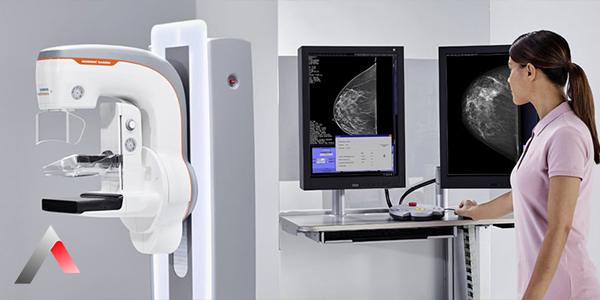
Digital mammography is a breast imaging method that uses low-dose X-rays to capture images of breast tissue. The obtained images are used to detect abnormalities, masses, or calcifications in the breast tissue. Digital mammography plays a crucial role in the early detection of breast cancer and increases the chances of successful treatment.
Mammography is performed for the following purposes:
Early detection of breast cancer: Mammography can detect tumors too small to be felt by physical examination. Early diagnosis increases the chances of successful breast cancer treatment.
Evaluation of breast diseases: Mammography can also be used to diagnose cysts, fibroadenomas, and other breast conditions.
Monitoring breast implants: Mammography can be performed to assess the condition of implants in women with breast implants.
Screening women with a family history of breast cancer: Women with a family history of breast cancer should begin mammography screenings at a younger age.
Breast Cancer is a type of cancer that occurs due to the uncontrolled division and growth of cells in breast tissue. It is the most common cancer among women. Early diagnosis and treatment increase the chances of recovery.
Symptoms of Breast Cancer:
Palpable lump in the breast
Changes in breast skin (redness, dimpling, orange peel texture)
Nipple retraction or discharge
Pain or tenderness in the breast
Swelling in the armpit
Risk Factors for Breast Cancer:
Age (risk increases with age)
Family history of breast cancer
Genetic factors
Early menstruation or late menopause
Not having children or having the first child after age 30
Use of hormone therapy
Obesity
Alcohol consumption
Smoking
Do not use deodorant, perfume, or lotion: These products can cause artifacts (distortions) on mammography images.
Wear comfortable clothing: Wear clothes that can be easily removed from the upper body.
Consider your menstrual cycle: Breasts may be more sensitive before menstruation. If possible, schedule your mammogram after your menstrual period.
Digital mammography has many advantages over traditional (film) mammography:
Image Quality: Digital mammography provides higher resolution images, making it easier to detect small abnormalities.
Radiation Dose: Digital mammography uses a lower dose of radiation.
Comfort: Digital mammography requires less compression of the breasts, making the procedure more comfortable.
Result Evaluation: Digital mammography images are stored and reviewed digitally, facilitating easier sharing and analysis of the images.
Mammography results are evaluated by a radiology specialist. The radiologist examines the images to determine if there are any abnormalities in the breast tissue.
BI-RADS Classification:
Mammography results are reported according to the BI-RADS (Breast Imaging Reporting and Data System) classification, which uses a scale from 0 to 6:
BI-RADS 0: Additional imaging needed for evaluation.
BI-RADS 1: Normal findings.
BI-RADS 2: Benign findings.
BI-RADS 3: Probably benign findings. Short-term follow-up recommended.
BI-RADS 4: Suspicious abnormality. Biopsy may be recommended.
BI-RADS 5: Highly suggestive of malignancy. Biopsy recommended.
BI-RADS 6: Known biopsy-proven malignancy.
Mammography prices may vary depending on the healthcare facility where the procedure is performed, the equipment used, and other factors.
A Life Health Group is a specialized healthcare provider in digital mammography services. Our experienced radiologists and technicians use the latest digital mammography technology to deliver the highest quality and most reliable service.
Advantages offered by A Life Health Group:
Experienced and expert staff: Our specialized radiologists and technicians work to provide you with the best service.
State-of-the-art equipment: We obtain high-quality images using the latest digital mammography devices.
Fast and reliable results: You can receive your mammography results quickly and accurately.
Comfortable and modern environment: We provide our services in a comfortable and modern setting.
Patient-centered approach: We tailor our care to the unique needs of each patient.
Protect your breast health with A Life Health Group!
Last Updated: 6 Kasım 2025 14:05
Publish Date: 18 Kasım 2024 20:46
Please fill in the fields below so that we can reach you
We are here for all your questions and problems 24/7.


 TR Türkçe
 EN English
 0 (850) 888 54 33


 E-Appointment
 E-Appointment
  E-Result






 0 (850) 888 54 33
 WhatsApp
 E-Appointment