
What is Cystectomy?

Cystectomy

Cystectomy is the surgical removal of the bladder, either partially or completely. While it is primarily used as a treatment for bladder cancer, it can also be employed in certain cases to address other conditions such as interstitial cystitis, neurogenic bladder, or recurrent infections.

This article will provide detailed information about the reasons for cystectomy surgery, its types, the surgical process, risks, complications, and the postoperative period.

Cystectomy_dc3ed3f7.webp

Why is Cystectomy Performed?

The most common reason for cystectomy surgery is bladder cancer. Bladder cancer is a type of cancer that begins in the cells lining the inner surface of the bladder. Early-stage bladder cancer usually remains confined to the inner surface of the bladder, while advanced-stage bladder cancer can spread to the bladder wall and even metastasize to lymph nodes or other organs. Cystectomy plays a crucial role in the treatment of advanced bladder cancers, especially muscle-invasive bladder cancer and high-grade non–muscle-invasive bladder cancer.

In addition to bladder cancer, cystectomy may also be performed in the following cases:

  • Interstitial cystitis: A condition that causes chronic inflammation in the bladder wall, leading to symptoms such as severe pain, frequent urination, and urgency.
  • Neurogenic bladder: A condition in which the bladder does not function properly due to problems related to the nervous system.
  • Recurrent infections: Frequent recurrent infections in the bladder may be one of the conditions requiring cystectomy.
  • Congenital bladder abnormalities: In rare cases, congenital bladder anomalies may also necessitate cystectomy.

Types of Cystectomy

Cystectomy surgery can be performed in different types depending on how much of the bladder is removed:

  • Radical Cystectomy: The most comprehensive type of cystectomy, involving the removal of the entire bladder, surrounding lymph nodes, and in men, the prostate and seminal vesicles, and in women, the uterus, ovaries, and part of the vagina. It is generally preferred for the treatment of advanced-stage bladder cancer.
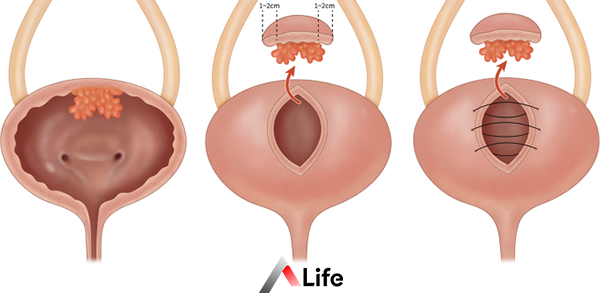
  • Partial Cystectomy: A method in which only the cancerous part of the bladder is removed. It is typically suitable for early-stage tumors located in a specific area of the bladder.
  • Simple Cystectomy: A method in which only the bladder is removed. It is generally preferred for conditions other than bladder cancer.

How is Cystectomy Performed?

Cystectomy surgery is performed under general anesthesia and usually takes 2–4 hours. The surgery can be carried out through open surgery, laparoscopic surgery, or robotic surgery.

  • Open Surgery: The bladder is accessed and removed through a large incision in the abdominal area.
  • Laparoscopic Surgery: Several small incisions are made in the abdominal area, and the bladder is removed using thin surgical instruments and a camera.
  • Robotic Surgery: Similar to laparoscopic surgery, but the surgeon uses a robotic system to control the procedure remotely.

After the bladder is removed, a new pathway must be created for urine to exit the body. This procedure is called urinary diversion. Urinary diversion methods include:

  • Ileal Conduit: A portion of the small intestine is used to create a channel that carries urine out through an opening in the abdominal wall (stoma). Patients attach a bag to the stoma to collect urine.
  • Neobladder: A portion of the small intestine is used to construct a new bladder inside the body. With this method, patients can urinate normally.
  • Continent Urostomy: A portion of the large intestine is used to create an internal reservoir for urine. Patients empty the reservoir at regular intervals using a catheter.

Risks and Complications of Cystectomy Surgery

As with any surgical procedure, cystectomy surgery carries certain risks and complications. These may include:

  • Bleeding
  • Infection
  • Urinary tract infection
  • Bowel obstruction
  • Urinary incontinence
  • Sexual dysfunction
  • Blood clot formation
  • Anesthesia-related complications

Postoperative Period of Cystectomy Surgery

The recovery process after cystectomy surgery may vary depending on the type of surgery, the patient’s overall health, and the urinary diversion method used. Patients usually stay in the hospital for several days after the surgery. Pain relievers and other medications may be used during the postoperative period. It is important for patients to carefully follow special care instructions to keep the urinary tract clean and prevent infections.

Patients who undergo urinary diversion receive training on stoma care or learning the functions of their new bladder. Physical therapy and rehabilitation can help accelerate recovery and assist patients in returning to their daily activities.

Life After Cystectomy Surgery

Life after cystectomy surgery can vary depending on the urinary diversion method used. Patients with an ileal conduit must be careful with stoma care and the use of a urine collection bag. Patients with a neobladder can urinate normally, but may experience issues such as urinary incontinence or nighttime urination. Patients with a continent urostomy must use a catheter to empty urine from the reservoir at regular intervals.

Cystectomy surgery can also affect sexual life. Men may experience erectile problems, and women may face issues such as vaginal dryness. It is possible to discuss appropriate treatment options with the specialist doctors at A Life Health Group.

What is Cystectomy?

Quick Application Form

Please fill in the fields below so that we can reach you

Related Units
Similar Contents

Do you need help?

We are here for all your questions and problems 24/7.